How Website Design Affects Customer Experience?
A website is often the first place where customers interact with a business. Before contacting a company, buying a product, or booking a service, people usually visit its website to learn more. This is why website design affects customer experience in many important ways.
A well-designed website can make visitors feel comfortable, help them find information quickly, and encourage them to take action. On the other hand, a confusing or outdated website can frustrate visitors and may cause them to leave.
Website design is not only about colors, images, and attractive layouts. It also includes website navigation, page speed, mobile responsiveness, readability, user interface, accessibility, and overall user experience (UX).
In this guide, we will explain how website design affects customer experience, why good web design matters, and how businesses can create a better website for their customers.
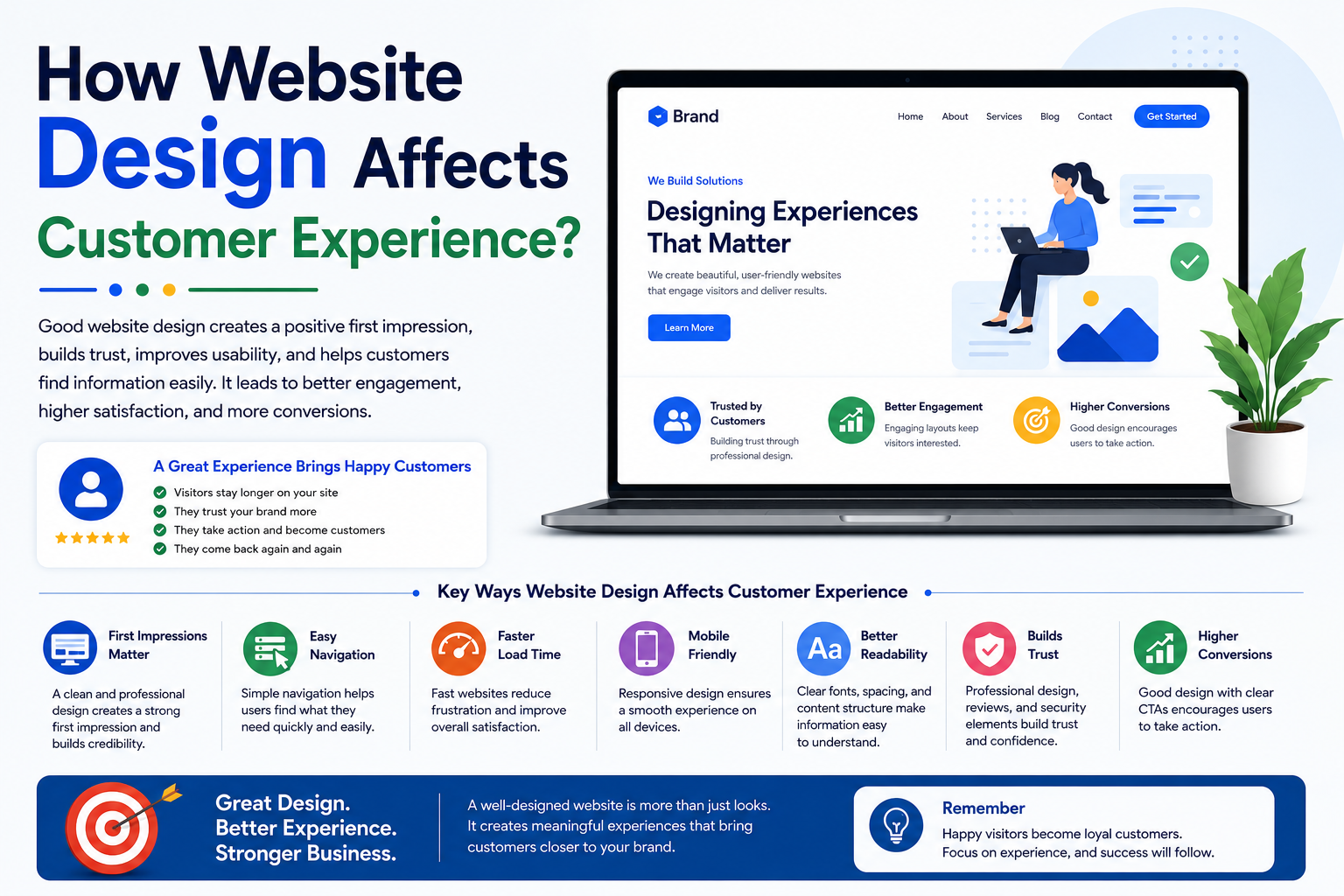
What Is Website Design?
Website design is the process of planning and creating the visual appearance, structure, and functionality of a website.
It includes different elements such as:
- Website layout
- Colors and typography
- Images and graphics
- Navigation menus
- Buttons and calls to action
- Page structure
- Mobile responsiveness
- Website speed
- User interface
- Content presentation
A good website design combines these elements to create a website that is attractive, easy to use, and helpful for visitors.
What Is Customer Experience?
Customer experience (CX) refers to how customers feel about their interactions with a business.
For a website, customer experience can include how easily visitors can:
- Find information
- Navigate between pages
- Read content
- Search for products or services
- Contact a business
- Complete a purchase
- Use the website on a mobile phone
- Understand what the business offers
A positive website experience can make visitors more comfortable and confident when interacting with a business.
How Website Design Affects Customer Experience
Website design can influence almost every part of a visitor’s journey. Let’s look at the major ways it affects customer experience.
1. First Impressions Matter
When someone visits a website for the first time, they quickly form an impression of the business.
A clean and professional website can communicate that a business takes its online presence seriously. A cluttered, outdated, or difficult-to-use website may create a negative first impression.
Important elements that influence first impressions include:
- Professional layout
- Consistent colors
- High-quality images
- Clear headings
- Easy navigation
- Readable content
- Proper spacing
Therefore, professional website design can help create a positive first impression.
2. Easy Navigation Improves User Experience
Website navigation helps visitors move from one page to another.
Imagine visiting a website where you cannot find the services page, contact information, or product categories. You may become frustrated and leave.
Good website navigation should be simple and logical.
For example, a business website might include:
Home | About Us | Services | Blog | Contact
Visitors should be able to understand the menu without thinking too much.
Simple navigation improves website usability and helps customers find the information they need quickly.
3. Website Speed Affects Customer Satisfaction
Nobody likes waiting for a website to load.
If a page takes too long to load, visitors may leave before seeing the content. This can create a poor customer experience.
Website speed can be affected by:
- Large images
- Too many plugins
- Unoptimized code
- Poor hosting
- Excessive scripts
- Unnecessary website elements
Businesses should focus on website speed optimization to provide a smoother experience.
A fast-loading website allows visitors to access information quickly and continue browsing without unnecessary delays.
4. Mobile-Friendly Design Is Essential
Many people access websites using smartphones. Therefore, a website should work properly across different screen sizes.
A mobile-friendly website should have:
- Responsive layouts
- Readable text
- Easy-to-click buttons
- Mobile-friendly menus
- Properly sized images
- Simple forms
Responsive web design allows a website to automatically adjust its layout according to the device being used.
If customers have to zoom in or scroll horizontally to read content, their experience may become frustrating.
5. Readability Makes Information Easier to Understand
Good website design should make content easy to read.
Visitors should not have to struggle to understand your website because of tiny fonts, poor spacing, or low contrast.
To improve website readability:
- Use clear fonts.
- Break content into short paragraphs.
- Use headings and subheadings.
- Use bullet points when appropriate.
- Maintain sufficient spacing.
- Use colors that provide good contrast.
Good website content design makes information easier for customers to understand.
6. Visual Design Builds Brand Perception
Your website is also an important part of your brand identity.
Colors, fonts, images, icons, and layouts can create a consistent visual identity.
For example, a professional business website may use a consistent color palette and typography throughout its pages.
Consistent web design and branding can help visitors recognize the business and understand its personality.
However, visual elements should support usability rather than make the website unnecessarily complicated.
7. Clear Calls to Action Help Customers
A call to action (CTA) tells visitors what to do next.
Examples include:
- Contact Us
- Buy Now
- Learn More
- Get a Quote
- Book Now
- Subscribe
- Download Now
If CTAs are difficult to find, visitors may not know what action to take.
Good website design places important CTAs where users can easily notice them while keeping the overall design clean.
8. Website Design Can Build Trust
Customers want to feel confident before sharing their information or making a purchase.
A professional website can support trust by providing:
- Clear contact information
- About Us information
- Customer reviews
- Testimonials
- Secure payment options
- Privacy information
- Professional images
- Clear product or service details
Trustworthy website design can make visitors feel more comfortable interacting with a business.
9. Good Design Can Improve Conversions
A website’s goal is often to encourage visitors to take a specific action.
For example, an e-commerce website may want visitors to purchase products, while a service-based business may want visitors to submit an inquiry.
A good conversion-focused website design makes the customer journey easier.
A simple journey might look like:
Landing Page → Product/Service Information → CTA → Contact/Purchase
When visitors can easily understand what a business offers and what to do next, the website can provide a smoother customer journey.
10. Accessibility Creates a Better Experience
A good website should be usable by as many people as possible.
Website accessibility means designing websites so that people with different abilities can interact with the content.
Some accessibility practices include:
- Adding descriptive alt text to images
- Using readable fonts
- Maintaining good color contrast
- Providing keyboard-friendly navigation
- Using clear headings
- Making forms understandable
Accessible web design can improve usability for a wider range of visitors.
Website Design and SEO
Website design also connects with search engine optimization (SEO).
SEO helps search engines understand and discover website content, while good design helps visitors use that content effectively.
Important areas where web design and SEO can work together include:
- Mobile-friendly design
- Page speed
- Website structure
- Internal linking
- Clear headings
- Image optimization
- User experience
- Responsive design
- Technical SEO
A website should therefore be designed for both search engines and users.
How to Improve Website Design for Better Customer Experience
Businesses can improve their website experience by following these simple practices:
1. Keep the Design Simple
Avoid unnecessary elements that make pages confusing.
2. Use Consistent Branding
Maintain consistent colors, fonts, and visual elements throughout the website.
3. Improve Website Speed
Compress images and remove unnecessary plugins or scripts.
4. Make the Website Mobile-Friendly
Test your website on smartphones and tablets.
5. Simplify Navigation
Make important pages easy to find.
6. Create Clear CTAs
Tell visitors what action they should take next.
7. Use High-Quality Images
Use relevant and optimized images that support your content.
8. Make Content Easy to Read
Use headings, short paragraphs, lists, and appropriate font sizes.
9. Add Trust Elements
Include reviews, testimonials, contact information, and other relevant trust signals.
10. Test Your Website Regularly
Check your website on different devices and browsers to identify usability problems.
Why Good Website Design Is Important for Businesses
A website is more than an online brochure. It is an important communication channel between a business and its customers.
Good website user experience can help visitors:
- Understand your business
- Find information faster
- Explore your products or services
- Contact you easily
- Feel more confident
- Complete desired actions
For businesses, this can support stronger customer engagement and a better online presence.
Conclusion
Understanding how website design affects customer experience is important for every business with an online presence.
A well-designed website can create a positive first impression, improve navigation, increase readability, support mobile users, build trust, and make it easier for customers to complete important actions.
Good website design is not simply about making a website look beautiful. It is about creating a website that is easy to use, fast, responsive, accessible, trustworthy, and helpful.
When businesses combine attractive design with good UX design, responsive web design, website usability, mobile optimization, page speed, and SEO, they can create a better experience for their visitors.
Ultimately, the best website design puts the customer first. When visitors can easily find what they need and understand what to do next, the website becomes a more useful and effective part of the overall customer journey.