E-Commerce Marketing: A Complete Beginner’s Guide
E-commerce marketing is an important part of digital marketing that helps online businesses attract customers, promote products, increase website traffic, and generate sales. As more people shop online, businesses need effective e-commerce marketing strategies to reach their target audience and build long-term customer relationships.
In this beginner-friendly guide, we will understand what e-commerce marketing is, why it is important, its major strategies, benefits, and how businesses can use it to grow online.
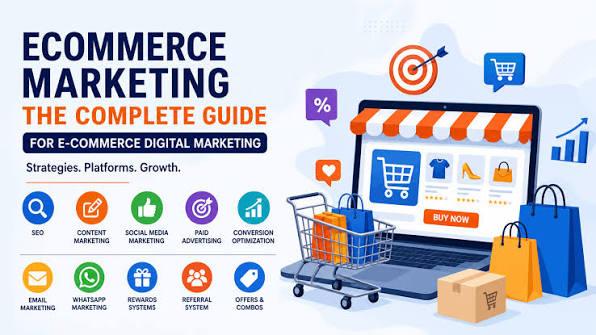
What Is E-Commerce Marketing?
E-commerce marketing refers to the use of online marketing techniques to promote products or services through an e-commerce website, online marketplace, social media, search engines, email, and other digital channels.
The main goal of e-commerce marketing is to bring potential customers to an online store and encourage them to take actions such as viewing products, adding items to a cart, making a purchase, or becoming a repeat customer.
For example, an online clothing store can use SEO to appear on Google, Instagram to showcase products, Google Ads to reach people searching for products, and email marketing to inform customers about new offers.
Why Is E-Commerce Marketing Important?
E-commerce marketing is important because simply creating an online store does not guarantee sales. Customers need to discover your products and understand why they should buy from your business.
A good e-commerce marketing strategy can help businesses:
- Increase online visibility
- Attract targeted customers
- Increase website traffic
- Generate leads and sales
- Build brand awareness
- Improve customer engagement
- Encourage repeat purchases
- Understand customer behavior
- Compete with other online businesses
Digital marketing gives e-commerce businesses multiple ways to reach customers throughout their buying journey.
1. E-Commerce SEO
E-commerce SEO is one of the most important strategies for increasing organic traffic to an online store.
Search engine optimization helps product and category pages appear in search engine results when people search for relevant products.
For example, if someone searches for “women’s cotton dresses online,” an optimized e-commerce website may appear in the search results.
Important e-commerce SEO practices include:
- Optimizing product titles
- Writing useful product descriptions
- Using relevant keywords
- Optimizing images and alt text
- Creating SEO-friendly URLs
- Improving website speed
- Using internal links
- Optimizing category pages
- Improving mobile usability
- Adding structured data where appropriate
A strong e-commerce SEO strategy can help businesses attract customers without relying completely on paid advertising.
2. Social Media Marketing for E-Commerce
Social media platforms are powerful channels for promoting products and building relationships with customers.
Businesses can use platforms such as Instagram, Facebook, YouTube, and Pinterest to share product images, videos, tutorials, customer reviews, and promotional content.
Social media marketing for e-commerce can help businesses:
- Showcase products
- Increase brand awareness
- Engage with customers
- Drive website traffic
- Promote offers
- Collect customer feedback
- Build an online community
Short videos, product demonstrations, tutorials, and user-generated content can make products easier for potential customers to understand.
3. Paid Advertising and PPC
Paid advertising allows businesses to reach specific audiences quickly.
PPC advertising means businesses generally pay when users click on their advertisements. Platforms such as Google Ads and social media advertising platforms can be used to promote e-commerce products.
Businesses can create campaigns based on factors such as:
- Keywords
- Location
- Demographics
- Interests
- Search behavior
- Previous website activity
For example, an online shoe store can run an advertisement for people searching for running shoes.
Paid advertising can support e-commerce sales, product launches, seasonal campaigns, and promotional offers.
4. Content Marketing for E-Commerce
Content marketing involves creating useful and relevant content that helps attract and educate potential customers.
For an e-commerce business, content can include:
- Blog posts
- Buying guides
- Product comparisons
- How-to articles
- Product videos
- Tutorials
- FAQs
- Customer stories
For example, a skincare store could publish an article about choosing skincare products for different skin types.
This type of content marketing for e-commerce can help attract organic traffic and build trust with potential customers.
5. Email Marketing
Email marketing is another useful strategy for online stores. Businesses can communicate directly with customers through newsletters, promotional emails, product updates, and personalized recommendations.
Common e-commerce email marketing campaigns include:
- Welcome emails
- New product announcements
- Discount emails
- Abandoned cart emails
- Order updates
- Product recommendations
- Re-engagement emails
For example, if a customer adds a product to their shopping cart but does not complete the purchase, an abandoned cart email may remind them about the product.
6. Influencer Marketing
Influencer marketing involves working with creators who have an audience interested in a particular niche.
For example, a fashion e-commerce brand may collaborate with a fashion creator to demonstrate its products.
Influencer marketing for e-commerce can help businesses reach new audiences and create product awareness.
Businesses should consider whether an influencer’s audience is relevant to their target customers rather than focusing only on follower count.
7. Conversion Rate Optimization
Getting visitors to an online store is only one part of e-commerce marketing. Businesses also need to make it easy for visitors to complete a purchase.
Conversion rate optimization (CRO) focuses on improving the customer journey and reducing unnecessary barriers to purchase.
Useful improvements can include:
- Clear product information
- High-quality product images
- Simple navigation
- Easy checkout
- Multiple payment options
- Clear calls to action
- Customer reviews
- Transparent shipping information
- Mobile-friendly design
A simple and user-friendly shopping experience can make it easier for customers to move from product discovery to purchase.
8. Mobile E-Commerce Marketing
Many customers use smartphones to browse products and shop online. Therefore, mobile optimization is an important part of an e-commerce marketing strategy.
An online store should work properly on different screen sizes and provide easy navigation on mobile devices.
Businesses should pay attention to:
- Mobile page speed
- Responsive design
- Easy-to-use menus
- Readable product information
- Mobile-friendly checkout
- Easy payment options
A poor mobile experience can make it difficult for customers to complete their purchases.
9. Customer Reviews and User-Generated Content
Customer reviews can provide useful information to potential buyers. Reviews, ratings, photos, and videos created by customers can also add social proof.
User-generated content (UGC) may include:
- Customer product photos
- Unboxing videos
- Product reviews
- Testimonials
- Social media posts
E-commerce businesses can encourage customers to share their experiences after purchasing a product.
10. E-Commerce Analytics
Analytics helps businesses understand how customers interact with their online store.
Businesses can analyze information such as:
- Website traffic
- Product views
- Conversion rate
- Sales
- Cart abandonment
- Traffic sources
- Customer behavior
- Campaign performance
E-commerce analytics allows businesses to understand which marketing activities are producing useful results and where improvements may be needed.
Benefits of E-Commerce Marketing
A well-planned e-commerce marketing strategy can provide several benefits:
Increased Online Visibility
SEO, social media, content marketing, and paid advertising can help more people discover an online store.
Better Customer Targeting
Digital marketing allows businesses to create campaigns for specific audiences based on relevant characteristics and online behavior.
Increased Sales Opportunities
Businesses can reach customers through multiple digital channels and provide different opportunities to discover products.
Stronger Brand Awareness
Consistent content and communication can help customers recognize an e-commerce brand.
Customer Retention
Email marketing, personalized communication, loyalty programs, and good customer service can help businesses maintain relationships with existing customers.
How to Create an E-Commerce Marketing Strategy
A simple e-commerce marketing plan can follow these steps:
Step 1: Identify your target audience.
Understand who your potential customers are and what products they need.
Step 2: Research keywords.
Find relevant search terms that customers use when looking for products.
Step 3: Optimize your website.
Improve product pages, navigation, mobile usability, speed, and checkout.
Step 4: Choose marketing channels.
Use SEO, social media, email marketing, paid advertising, content marketing, or other suitable channels.
Step 5: Create useful content.
Publish product information, guides, videos, and educational content.
Step 6: Track performance.
Monitor traffic, conversions, sales, and campaign performance.
Step 7: Improve continuously.
Use your data to identify areas that can be optimized.
Conclusion
E-commerce marketing helps online businesses attract potential customers, promote products, increase website traffic, generate sales, and build lasting customer relationships. Strategies such as e-commerce SEO, social media marketing, content marketing, PPC advertising, email marketing, influencer marketing, conversion rate optimization, and analytics can work together to create a strong online presence.
For beginners, the most important step is to understand the target audience, create a user-friendly website, provide useful content, and choose marketing channels that match the business and its customers. With consistent optimization and measurement, e-commerce marketing can become an important part of an online business growth strategy.