What Is Content Marketing? A Complete Beginner’s Guide
In today’s digital world, businesses need more than traditional advertising to attract customers. People search online for information, compare different products, read reviews, and watch videos before making purchasing decisions. This is where content marketing becomes important.
Content marketing helps businesses attract and educate their target audience by creating and sharing useful, relevant, and valuable content. Instead of focusing only on selling products, businesses use content to answer questions, solve problems, build trust, and develop long-term relationships with customers.
In this complete beginner’s guide, we will explain what content marketing is, how it works, its benefits, different types of content, content marketing strategies, and how businesses can use content marketing to grow online.
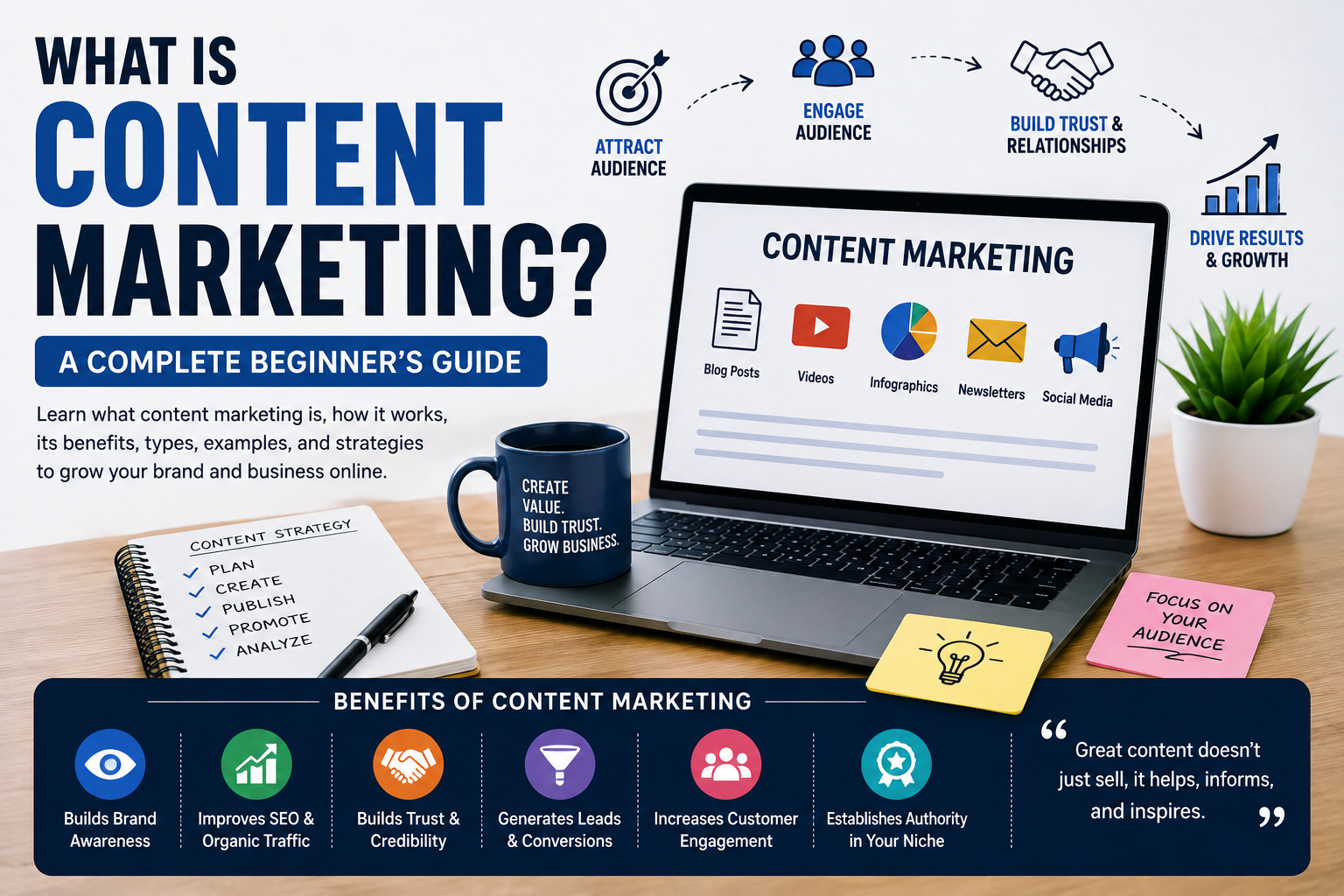
What Is Content Marketing?
Content marketing is a digital marketing strategy that involves creating and distributing valuable, relevant, and consistent content to attract and engage a specific target audience.
The main goal of content marketing is to provide useful information that helps an audience while supporting business objectives such as brand awareness, website traffic, lead generation, and customer relationships.
Content can be published on websites, blogs, social media platforms, email newsletters, video platforms, and other digital channels.
For example, a digital marketing agency could publish a blog about SEO tips for beginners. Someone searching for SEO information may discover the blog, learn something useful, and later become interested in the agency’s services.
Why Is Content Marketing Important?
Content marketing is an important part of modern digital marketing because customers often research information before making a decision.
Instead of directly promoting a product in every piece of content, businesses can educate their audience and provide solutions to common problems.
Some important reasons for using content marketing include:
- Building brand awareness
- Increasing website traffic
- Improving online visibility
- Generating leads
- Building customer trust
- Supporting SEO
- Increasing audience engagement
- Establishing industry authority
A well-planned content marketing strategy can support a business throughout the customer journey, from awareness to consideration and eventually conversion.
How Does Content Marketing Work?
Content marketing generally follows a simple process.
1. Understand Your Target Audience
Before creating content, businesses need to understand their target audience.
Ask questions such as:
- Who are your potential customers?
- What problems do they have?
- What information are they searching for?
- Which platforms do they use?
- What type of content do they prefer?
Understanding your audience helps you create content that is useful and relevant.
2. Research Topics and Keywords
Keyword research is an important part of SEO content marketing.
Businesses can research the words and phrases people use when searching online. These keywords can then be used naturally in blog posts, website pages, videos, and other content.
For example, a digital marketing website may target keywords such as:
- Content marketing
- Content marketing strategy
- Content marketing examples
- Benefits of content marketing
- Content marketing for beginners
Keyword research can help content creators understand what topics their audience is interested in.
3. Create Valuable Content
The next step is content creation.
The content should provide useful information rather than simply repeating promotional messages.
Good content should be:
- Helpful
- Relevant
- Easy to understand
- Accurate
- Well-structured
- Original
Businesses can create different types of content depending on their audience and goals.
Types of Content Marketing
There are many different types of content marketing that businesses can use.
1. Blog Posts
Blogging is one of the most common forms of content marketing.
Businesses can create articles that answer customer questions, explain industry topics, provide tutorials, or share useful tips.
SEO-friendly blog posts can also help websites attract organic traffic from search engines.
2. Video Content
Video marketing is another popular form of content creation.
Businesses can create:
- Tutorials
- Product demonstrations
- Educational videos
- Interviews
- Short-form videos
- Behind-the-scenes content
Video content can make complex information easier to understand and can be shared across multiple platforms.
3. Social Media Content
Businesses can use social media to distribute short and engaging content.
Examples include:
- Instagram posts
- Reels
- Stories
- LinkedIn posts
- Facebook posts
- YouTube Shorts
Social media content can help businesses increase engagement and build brand awareness.
4. Infographics
Infographics combine text and visuals to explain information in an easy-to-understand format.
They can be particularly useful for statistics, processes, comparisons, and educational topics.
5. Email Content
Email marketing can also be part of a content marketing strategy.
Businesses can send subscribers:
- Newsletters
- Educational articles
- Product updates
- Tips
- Special offers
- Company news
Useful email content can help businesses maintain communication with their audience.
Benefits of Content Marketing
There are several content marketing benefits for businesses.
Builds Brand Awareness
Regularly publishing useful content can help more people discover and recognize a business.
Increases Website Traffic
SEO-optimized content can attract visitors from search engines and other digital channels.
Supports SEO
Content marketing and SEO work closely together. Search engines need useful content to understand what a website is about.
Creating high-quality content around relevant topics and keywords can support organic search visibility.
Builds Trust
When a business consistently provides helpful information, it can demonstrate knowledge and expertise in its industry.
This can help build brand credibility and customer trust.
Generates Leads
Content can encourage visitors to take actions such as subscribing to a newsletter, downloading a resource, requesting information, or contacting a business.
This makes content marketing useful for lead generation.
Content Marketing Strategy
A successful content marketing strategy should have clear goals.
A basic strategy can include these steps:
Set Your Goals
Decide what you want your content to achieve.
Your goals might include:
- Increasing website traffic
- Building brand awareness
- Generating leads
- Improving SEO
- Increasing engagement
- Supporting sales
Choose Content Topics
Select topics that are relevant to your audience and connected to your products or services.
Create a Content Calendar
A content calendar helps organize your publishing schedule.
It can include:
- Topic
- Keyword
- Content type
- Publishing date
- Platform
- Content status
Optimize Content for SEO
Use your target keyword naturally in important areas such as:
- Page title
- Main heading
- Introduction
- Subheadings
- URL
- Meta description
- Image alt text
However, avoid excessive keyword repetition. Keyword stuffing can make content difficult to read and is not a good SEO practice.
Distribute Your Content
Creating content is only one part of content marketing. Businesses also need content distribution.
Content can be distributed through:
- Search engines
- Social media
- Email newsletters
- Online communities
- Business websites
- Video platforms
Content Marketing Examples
Here are some simple content marketing examples:
A clothing brand can create a blog titled “How to Style Casual Outfits for Summer.”
A fitness business can publish a video about “Beginner Workout Tips.”
A digital marketing agency can publish an article about “SEO Tips for Small Businesses.”
An e-commerce business can create an infographic explaining “How to Choose the Right Product.”
These examples provide useful information while introducing the audience to the business.
How to Measure Content Marketing Success
Businesses should track their content performance to understand what is working.
Important metrics include:
- Website traffic
- Organic traffic
- Page views
- Engagement
- Social shares
- Leads
- Conversion rate
- Email subscriptions
- Time spent on a page
Analytics can help businesses improve their future content marketing campaigns.
Conclusion
Content marketing is an important part of digital marketing that helps businesses attract, educate, and engage their target audience. By creating useful content such as blogs, videos, social media posts, infographics, and emails, businesses can build awareness, increase website traffic, improve SEO, generate leads, and build customer trust.
A successful content marketing strategy requires understanding your audience, researching relevant topics and keywords, creating valuable content, distributing it through the right channels, and measuring its performance.
For beginners, the best approach is to start with a few relevant topics, create high-quality content consistently, and improve the strategy based on audience response and performance data.